
Understanding Mandarin Chinese, traditional and simplified characters, and why language differences matter for young learners.
By The Socratic School of Language
When parents enroll their children in Mandarin Chinese classes, they expect their children to develop language skills, cultural awareness, and confidence in communicating. But did you know that not all Mandarin Chinese programs teach the language in exactly the same way?
Differences in writing systems, pronunciation methods, and regional vocabulary can influence how children experience language learning.
For parents investing in early childhood language education, understanding these differences matters.
A Classroom Observation That Sparked an Important Conversation
Recently, one of our Mandarin educators reviewed assignments a student had completed through another language program. She noticed that the materials reflected a different Chinese writing and pronunciation system from the one used in our Saturday Mandarin Academy.
This observation sparked an important conversation among our educators: What happens when young children learn Mandarin through different instructional approaches?
And how can teachers help children connect what they’re learning?
Traditional vs. Simplified Chinese: What’s the Difference?
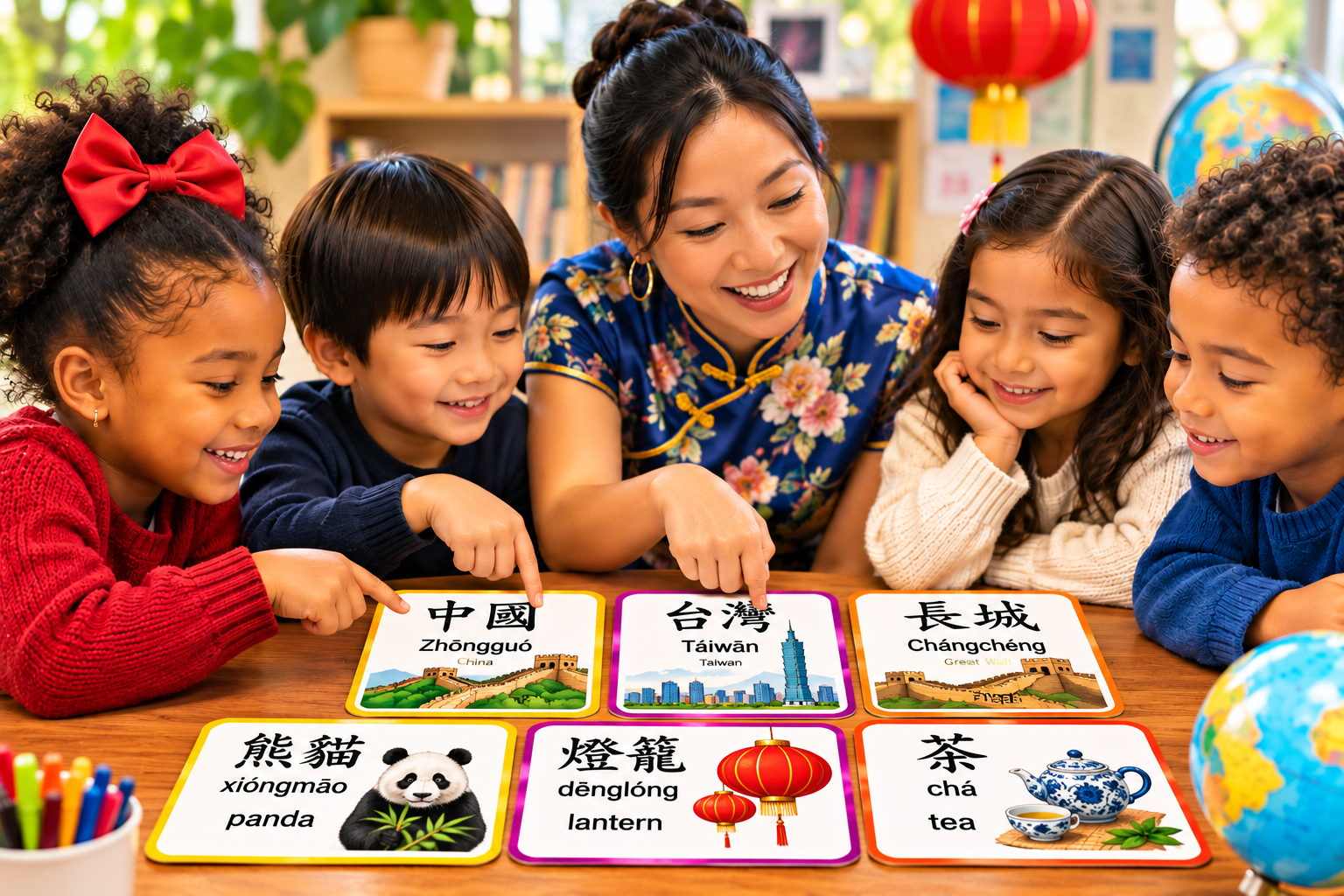
Mandarin Chinese is spoken in both mainland China and Taiwan, but the written and instructional systems commonly used in these regions differ.
In mainland China, Mandarin is generally taught using simplified Chinese characters and Hanyu Pinyin, a Roman-letter system that helps learners understand pronunciation and tones.
In Taiwan, Mandarin is commonly taught using traditional Chinese characters and Zhuyin, also known as Bopomofo, a phonetic system using its own symbols.
For example, the Chinese word for horse is written:
- 马 in simplified Chinese
- 馬 in traditional Chinese
Both represent the same Mandarin word, pronounced mǎ.
Neither writing system is inherently superior. However, children moving between them may benefit from guidance in recognizing equivalent characters and understanding different phonetic systems.
Language Differences Exist in Spanish and Arabic, Too
At The Socratic School of Language, we’ve observed similar variations in other languages.
In Spanish, brown may be called marrón or café. Purple may be morado or púrpura. Depending on the region, a banana may be called banana or plátano.
Arabic also has regional spoken varieties that differ from Modern Standard Arabic, commonly used in formal writing and education.
These differences aren’t mistakes. They reflect the cultural richness of the world’s languages.
Can Learning Different Language Systems Confuse Children?
Fortunately, research provides encouraging answers.
The American Academy of Pediatrics explains that learning multiple languages does not inherently cause language delays or confusion. Children are capable of navigating different linguistic systems, even at young ages.
Still, thoughtful instruction matters.
A child learning simplified Chinese at one school and traditional Chinese at another may need additional support connecting characters, sounds, and vocabulary.
The goal isn’t to eliminate language differences. It’s to help children understand them.
What Should Parents Ask Before Choosing Mandarin Classes?
Whether you’re exploring Mandarin classes for children in Washington, DC, Maryland, or Northern Virginia, consider asking:
- Is the program teaching Mandarin, Cantonese, or another Chinese language?
- Does instruction use simplified or traditional Chinese characters?
- Are pronunciation skills taught through Pinyin, Zhuyin, or another approach?
- How does the program support children learning Chinese elsewhere?
These questions help families make informed choices and understand the education they’re purchasing.
Our Approach to Early Childhood Language Learning
At The Socratic School of Language, we believe successful language acquisition requires more than vocabulary memorization.
Our educators observe, communicate, and adapt instruction to support each child’s development.
Through our Saturday Immersion Academy, we introduce children to Mandarin Chinese in an engaging, supportive environment that encourages curiosity, confidence, and cultural appreciation.
Because language learning isn’t simply about learning new words.
It’s about understanding the language, appreciating its cultural context, and building connections that last a lifetime.
Interested in Mandarin Chinese classes for your child? Explore The Socratic School of Language’s daily school program or Saturday Immersion Academy and discover how early language exposure can enrich your child’s educational journey.